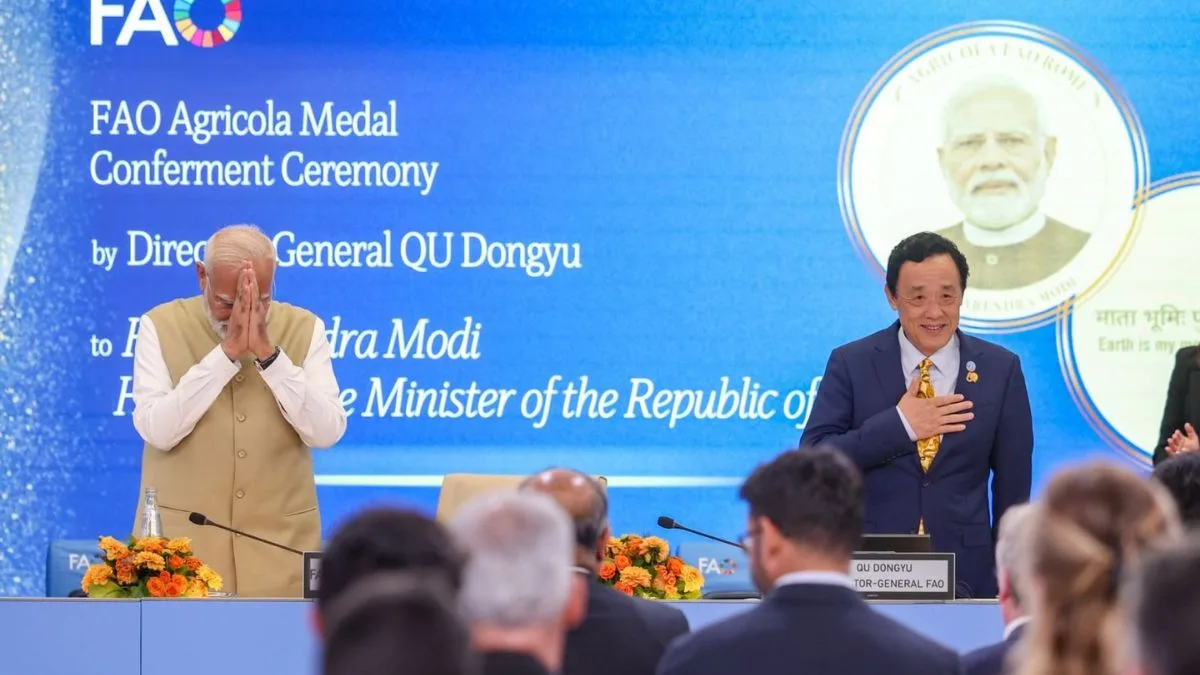
Prime Minister Narendra Modi on Wednesday received the prestigious Agricola Medal from the Food and Agriculture Organization (FAO) of the United Nations in Rome, using the occasion to pitch India’s agriculture model as a blend of tradition, technology and sustainability.
After the event, PM Modi also reiterated India’s push for millet cultivation in a post on X. In the post, the Prime Minister said Indian farmers were contributing not only towards nutrition security through millet cultivation, but also rendering a major service to the environment.
Advertisement
Accepting the honour at the FAO Headquarters, PM Modi dedicated the award to India’s farmers, cattle rearers, fishermen, agricultural scientists and workers, saying the recognition reflected the country’s commitment to food security, human welfare and sustainable development.
The award comes at a time when India is increasingly projecting its agricultural policies and climate-resilient farming practices on global platforms, particularly among countries of the Global South. During his address, PM Modi highlighted India’s push for precision farming, digital agriculture and millet cultivation, while also underlining the country’s role in global food security despite having only 2.5 per cent of the world’s agricultural land.
“This honour is not just for me; it belongs to the billions of farmers, cattle herders, fishermen, agricultural scientists, and our workers in India,” PM Modi said while receiving the medal from FAO Director-General Qu Dongyu.
Calling agriculture central to India’s civilisational identity, the Prime Minister said farming in the country was not merely an economic activity but a “deep and sacred relationship between human beings and Mother Earth”.
“In India, the earth is called Mother, and the farmer is given the title of ‘Son of the Earth’,” he said.
PM Modi highlights technology push in Indian agriculture
PM Modi said India was increasingly relying on science and technology to make agriculture climate-resilient and future-ready. He cited initiatives such as Soil Health Cards, micro-irrigation campaigns under the “Per Drop More Crop” programme, AI-based advisory systems, drones and sensor-driven farming technologies.
According to him, digital public infrastructure platforms like AgriStack were helping even small farmers access weather forecasts, crop advisories and market information through mobile technology.
“Technology is becoming the new strength of Indian agriculture today,” he said.
The Prime Minister also claimed that India had developed nearly 3,000 climate-resilient crop varieties over the past decade, adding that the focus was shifting from merely increasing production to “producing better”.
He said India’s agricultural exports had risen from USD 35 billion in 2020 to more than USD 51 billion last year.
Millets, nutrition and India’s partnership with FAO
During the address, PM Modi referred to India’s partnership with FAO during the International Year of Millets campaign, saying the initiative helped bring global attention to traditional grains.
He described millets as environment-friendly crops requiring less water and fewer chemical inputs, particularly beneficial for small farmers dependent on rainfall.
“I have seen that whenever millets are discussed, everyone’s attention goes to nutrition. But millets are also an environment-friendly crop,” he said.
PM Modi also recalled India’s long association with the FAO and mentioned contributions made by Indian agricultural scientists such as Dr MS Swaminathan and Dr Binay Ranjan Sen towards global food security efforts.
Towards the end of his speech, the Prime Minister lightened the mood by referring to himself as a “chai-wala” ahead of International Tea Day celebrations.
“To celebrate Tea Day, a ‘Chai-wala’ has come among you a day in advance,” he remarked.
FAO Director-General Qu Dongyu, while presenting the medal, described PM Modi as “a symbol of hope for India’s rural masses” and praised India’s efforts towards food security.
Prime Minister Modi’s visit to the FAO Headquarters marked the first visit by an Indian Head of Government to the organisation in nearly three decades.